A supernova is a gigantic, bright explosion that ejects most of the dead star’s mass into space. They briefly outshine entire galaxies, and can be caused in two ways: one in a binary star system (called Type I), the other in a single star’s life cycle (Type II).
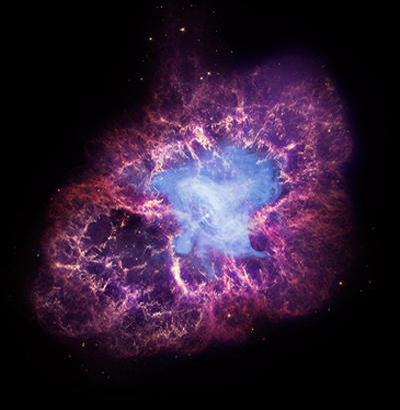
In the binary system, or Type I supernova, one White Dwarf star absorbs mass from the other, eventually causing it to explode from the excessive mass.

In the singular star cycle, or Type II supernova, the star runs out of fuel, and its mass flows to its core. The excessive mass causes a core collapse and explosion. Afterwards, what is left is the mass of our sun… contained in area roughly the size of a city. These are called neutron stars.

About once every second, somewhere in the universe, a supernova goes off. In a galaxy like the Milky Way, there’s one roughly every 50 years.

To become a supernova, a star has to be roughly 8-15 times our sun’s mass. It’s estimated that stars 20-30 times our sun’s mass become black holes when they die.
The sun is a G2V and main sequence star, and does not have enough mass to become a supernova. When it runs out of fuel, it will swell to a red giant before shrinking to white dwarf.

